


Representatives from the IG Nobel organisation, based in the United States, visit Lund University together with members of The Young Academy of Sweden. Among the visitors is Marc Abrahams, founder and editor of the Annals of Improbable Research and the driving force behind the annual IG Nobel Prizes. The visit is arranged by Lund University’s Academic Ceremonies and Events Office (akademiintendentur).
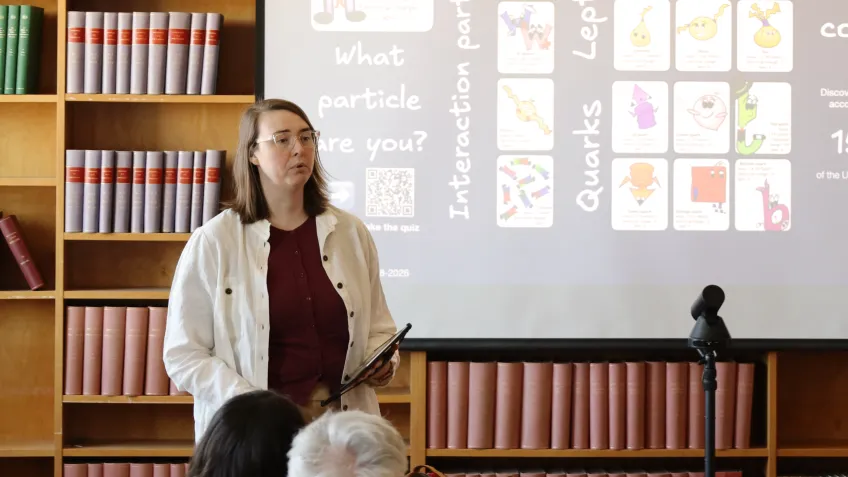
At the Department of Physics, the guests meet with researchers for a series of presentations showcasing playful yet rigorous physics research. The talks reflect the IG Nobel philosophy: research that may at first seem surprising or unconventional, but that opens new ways of thinking and contributes to serious scientific understanding.
The programme spans a wide range of topics. Presentations include attosecond physics, where ultra‑short flashes of light are created to study extremely fast processes in matter, as well as quantum physics, featuring imaginative discussions on how quantum entanglement might even be used to improve strategies in games such as bridge. Other talks explore particle physics, focusing on how both known and yet‑unknown particles can be detected, and nanoscience, where new devices are designed and built at the nanoscale.
Under the visit, four members of academic staff at the Department of Physics present their research. Two are assistant senior lecturers and two are senior lecturers.


At the end of the programme, Marc Abrahams expresses his enthusiasm for the presentations, describing them as exceptional.
“I don’t think I have ever heard presentations like these in physics, this is truly unique,” he says, praising the presenters’ ability to communicate advanced research with a brilliant sense of humour.
Together, the visit offers a joyful reminder of how curiosity‑driven research can combine creativity with scientific rigour. This balance lies at the heart of the IG Nobel mission: research that first makes people laugh – and then think.
The IG Nobel Prize is organized by the Improbable Research organization.